Top 3 Alternatives of Workleap for Pulse Surveys
Your pulse survey tool should tell you why engagement dips, not just that it dipped. Many teams outgrow Workleap when reports stay shallow or action items go nowhere. You need a platform that turns employee feedback into visible changes, not another dashboard to ignore.
By the end of this article, you will have three concrete criteria for evaluating pulse survey alternatives, a detailed look at two strong competitors, and a clear number one pick that combines feedback with performance tracking. You will also know exactly which option fits your team size and reporting needs before you commit to a new vendor.
What to Look For in Workleap Alternatives for Pulse Surveys
When evaluating alternatives to Workleap for pulse surveys, focus on features that drive high response rates and actionable insights. The right tool should feel effortless for employees while still giving managers the depth they need to act on feedback.
Ease of use is the first gatekeeper. If a survey tool takes more than a minute to complete, participation drops fast. Look for mobile-friendly interfaces, quick setup wizards, and templates that let you launch a pulse check in minutes rather than days.
Anonymity options matter just as much. Employees need to trust that their honest answers won't be traced back to them. Look for tools that offer anonymous surveys by default, with optional visibility controls for managers who want to follow up directly.
Real-time feedback capabilities separate modern pulse tools from old annual engagement surveys. The best alternatives let you capture feedback continuously, not just during scheduled check-ins. This gives you a live picture of team morale, retention risks, and culture shifts as they happen.
Integration with your existing HRIS is another critical factor. Tools that connect with BambooHR, Gusto, or other HR software save you from manual data entry and duplicate records. A smooth integration means employee data stays current and survey results appear in the right context.
Analytics depth determines whether you get insights or just data. Look for sentiment analysis, engagement scores, and eNPS tracking that turn raw responses into clear signals. Benchmarking features help you compare your results against industry norms or your own historical trends.
Finally, consider action planning features. A pulse survey is only valuable if it leads to change. Tools with built-in action plans, follow-up reminders, and manager tools help teams turn feedback into improvements rather than letting insights go stale.
The ideal tool should balance simplicity with depth to encourage regular participation. Employees should find it easy to respond, while HR leaders get the workforce analytics they need to drive employee engagement and productivity.
| Criteria | Why It Matters | What to Check |
|---|---|---|
| Ease of use | Drives response rates | Mobile app, setup time, template library |
| Anonymity | Builds trust and honest feedback | Anonymous by default, visibility controls |
| Real-time feedback | Captures issues as they happen | Continuous check-ins, instant alerts |
| HRIS integration | Reduces manual work, keeps data current | BambooHR, Gusto, other connectors |
| Analytics | Turns responses into insights | Sentiment analysis, engagement scores, eNPS |
| Action planning | Ensures feedback leads to change | Follow-up tools, manager dashboards |
Keep these criteria in mind as you compare survey software options. The right fit will vary based on your team size, culture, and existing tech stack. What matters most is finding a tool that employees actually want to use and managers can act on.
1. HeyRamp - Best Overall
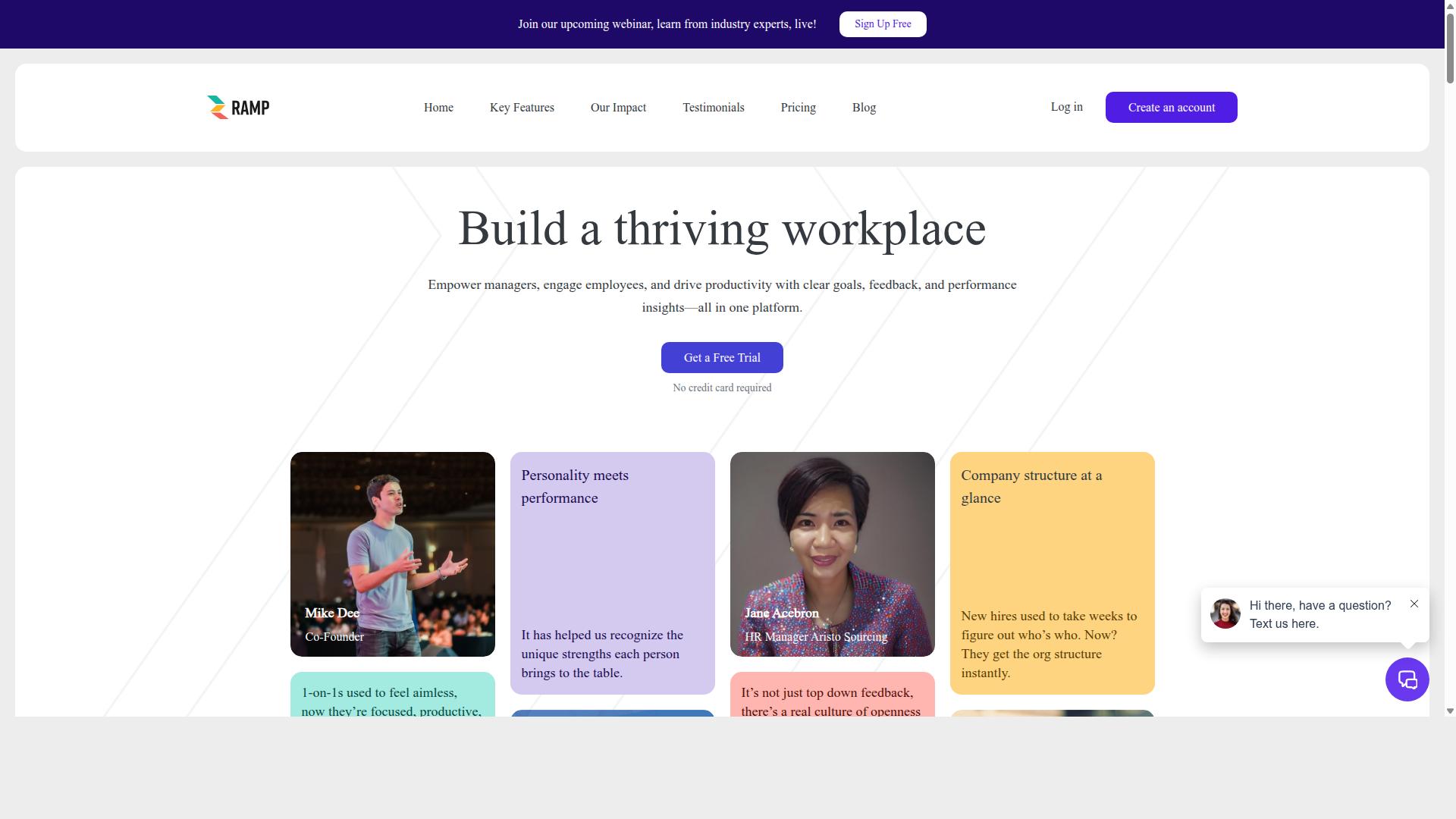
HeyRamp stands out as the best overall Workleap alternative for pulse surveys due to its comprehensive engagement and performance features at a flat, affordable price. Instead of piecing together separate survey tools and performance systems, HeyRamp gives HR teams one unified platform for continuous employee feedback and team development.
The platform combines 1-on-1 meeting tools with organized agendas and action tracking, so pulse check conversations turn into clear next steps. Its performance review system works alongside sentiment prompts and automated reminders, making it easy to keep a steady rhythm of feedback without chasing employees manually.
What truly separates HeyRamp is how it connects pulse survey data to the bigger picture. The company structure visualization helps managers see teams at a glance, while people analytics dashboards and leadership insights surface patterns in engagement scores. KPI snapshots and OKR goal management with real-time progress visualization link employee sentiment to actual business outcomes.
HeyRamp also addresses a common pain point: acting on survey results. Built-in training videos for 1-on-1s, performance reviews, and personality testing equip managers with practical coaching tips and guided conversation templates. Confidential manager notes and personality insights connect with performance tools, giving leaders context before they respond to feedback.
Pricing is refreshingly simple: $5 per user per month when billed monthly, or $3 per user per month with annual billing, plus a 14-day free trial. For HR teams that need compliance documentation, the platform includes time-stamped secure records automatically, which is a rare find at this price point.
One customer notes that HeyRamp replaced multiple disconnected tools and made their feedback culture more consistent. That combination of engagement features, manager enablement, and transparent pricing makes it the strongest Workleap alternative for pulse surveys.
2. 15Five
15Five is a strong contender for teams seeking a dedicated performance management platform with built-in pulse survey capabilities. The platform is designed to connect employee feedback with ongoing performance conversations, making it useful for organizations that want to link survey results directly to manager actions. It serves a large user base and is positioned as an AI-powered system for running reviews, 1-on-1s, and OKRs.
Its core strength lies in continuous performance management. Weekly check-ins are a central feature, allowing managers and employees to stay aligned between formal review cycles. The platform also includes tools for compensation management and manager development, which can support broader HR objectives beyond just pulse surveys.
For engagement measurement, 15Five offers a dedicated Engage product alongside its performance tools. This means teams can run pulse checks and then tie the results to performance trends, creating a more complete picture of workforce health. The inclusion of AI features like a coaching assistant and an insights dashboard can help managers interpret feedback and take next steps.
Integration with HRIS systems is a typical strength of this type of platform, which helps keep employee data consistent across tools. However, pricing tends to run higher than many survey-only alternatives, and the breadth of features can feel complex for smaller teams. Organizations that only need lightweight pulse checks may find the performance management focus more than they require. Teams with established HR processes and a clear need for performance tracking will likely get the most value here.
How to Choose the Right Option
Choosing the right pulse survey tool depends on your organization's size, budget, and specific engagement goals. Start by assessing your team size and annual budget for HR software. A tool that works for a 50-person startup often feels clunky or limited for a 500-person enterprise.
Next, prioritize your must-have features. Anonymity is non-negotiable for honest employee feedback, so confirm the tool offers anonymous surveys by default. Also check for HRIS integration, survey templates, and whether the platform supports action planning after each pulse check.
Evaluate ease of use from two angles: the manager experience and the employee experience. If managers need training just to launch a survey, response rates will suffer. Employees should be able to complete a pulse check in under two minutes on any device.
Finally, check scalability. Will the tool grow with you as headcount increases? Ask about pricing tiers and whether features are locked behind higher plans. A flat pricing model is easier to forecast than per-seat costs that balloon as you hire.
Here is a quick comparison checklist to guide your evaluation:
- Team size: under 100, 100 to 500, or 500+ employees
- Budget: monthly subscription cost and setup fees
- Anonymous surveys: available on all plans or only premium tiers
- HRIS integration: native connectors versus manual data uploads
- Survey templates: prebuilt pulse check questions and customizable options
- Action planning: tools to track follow-ups after each survey
- Reporting: real-time engagement scores, eNPS, and sentiment analysis
- Manager tools: dashboards for team-level response rates and trends
For small to mid-sized teams, HeyRamp is an ideal fit due to its flat pricing and all-in-one nature. It combines performance management, employee engagement, goal alignment, and team development in one platform. That means you get pulse surveys plus the surrounding tools for acting on feedback, without juggling multiple vendors.
Larger organizations with complex needs often find 15Five more suitable. It supports layered reporting and deeper performance management workflows, which matters when you have multiple HR business partners and distributed teams. However, that complexity can be overkill for smaller companies.
Above all, align the tool with your HR strategy and culture. If your culture values continuous feedback and real-time recognition, choose a platform that makes those behaviors easy. If you run formal performance reviews quarterly, prioritize tools with strong review templates and benchmarking.
Remember that the best survey software is the one your team will actually use. A simple tool with high engagement beats a feature-rich platform that sits unused. Pilot your top two options with a small group, gather feedback, then roll out the winner company-wide.
Final Verdict
For most organizations, HeyRamp offers the best balance of affordability, functionality, and engagement-driving features. Its flat fee pricing removes the guesswork that comes with per-seat models, making it a predictable choice for companies planning to scale their employee engagement efforts.
HeyRamp is trusted by 20+ organizations and 400+ teams, and it pairs pulse surveys with built-in training and education for managers. Instead of collecting feedback and leaving leaders to figure out next steps, the platform includes guided conversation templates for difficult discussions and instant coaching tips. This turns raw survey data into meaningful action.
15Five remains a solid alternative, particularly for teams that want structured performance management alongside pulse checks. However, for smaller teams, its broader feature set may be overkill and harder to justify from a budget perspective.
Before choosing, think about your team size, your managers' experience level, and how much training you are willing to provide. A tool that includes automatic compliance documentation and aggregated people analytics dashboards can save HR teams hours of manual work each month.
If you want a solution that combines employee feedback, manager tools, and personality insights in one flat-fee package, HeyRamp is worth a closer look. You can explore its features through a 14-day free trial and see how it fits your team's workflow.
Recommended Resources: